

everything i read in july
the theme is: dead things you really care about

Hot, sticky, languid, laborious July. At this point in the summer, the season has lost all but its most devoted lovers to the promise of cooler weather. At some point, about halfway through the month, without fail, you’ll start hearing whispers of “I’m so excited for fall,” and in these climate change-addled summer temperatures, can you blame anyone?
I didn't get a lot of reading done in July for all sorts of mopey personal reasons I have enough tact to not get into here or online at all, but all three books that I did finish felt like they continued my theme from June, girlhood, in their own and more morbid ways.
Something about reading all this girlhood and death has made me feel very nostalgic, especially since I’m experiencing an intense bout of homesickness right now. For both place and people, though certainly not for girlhood itself; I will take the hardships of adulthood over the unsteadiness of childhood, thanks! But still, many reasons to reflect and ponder and maybe come out better or more sure of myself on the other side. And isn’t that why we’re reading all these books to begin with.


the books
All three of these are, impressively, debut novels by women. I don’t necessarily give debut novels a more forgiving eye, but I am more impressed. I’m always shocked someone can write a whole book and then convince everyone to read it. At that point, who cares if it’s any good? You’re still holding your published book in your hands.
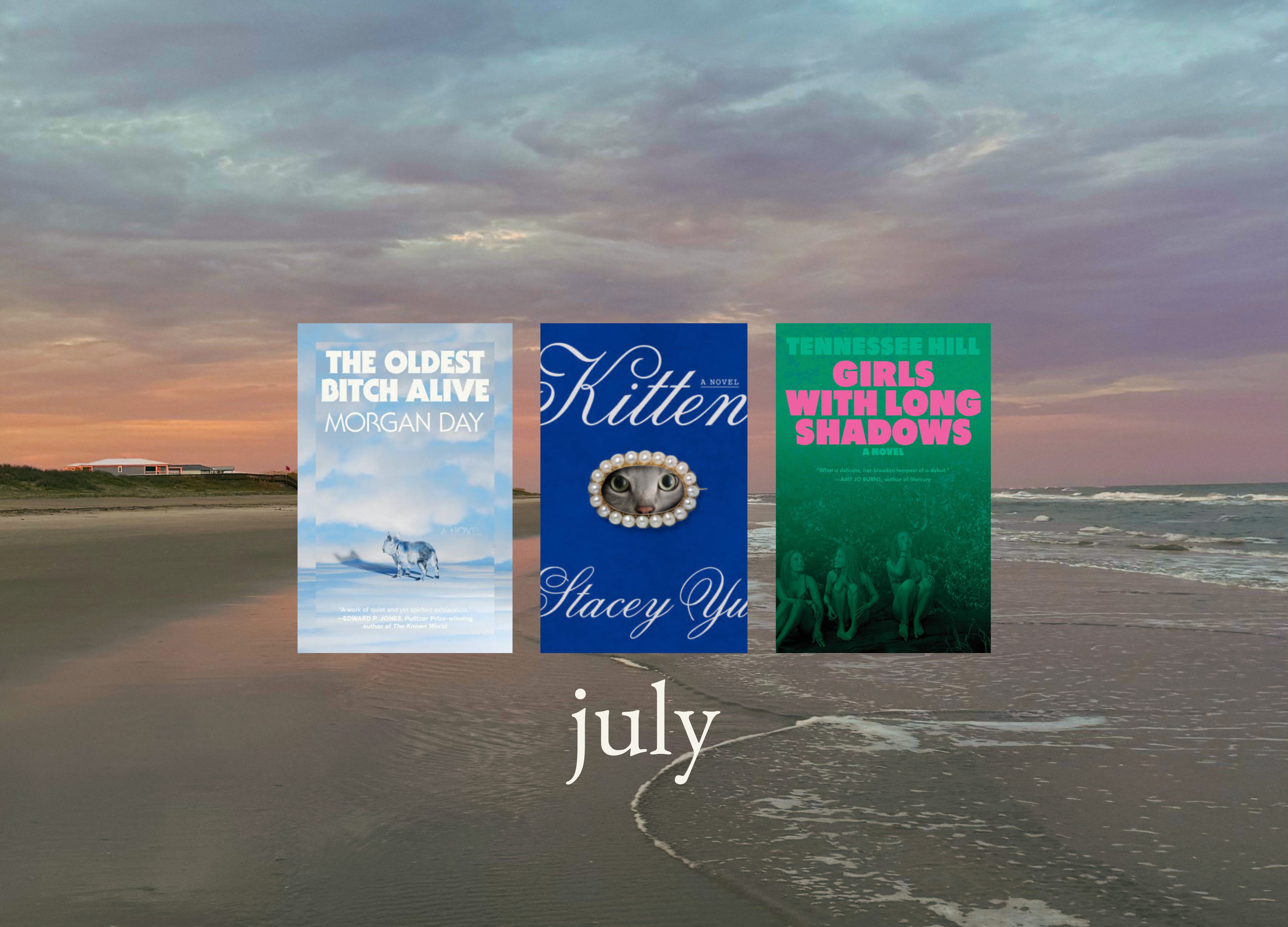
The Oldest Bitch Alive by Morgan Day
I've really struggled with how to discuss this book because it's unlike anything I've read before and all of the language I have to think about it doesn't feel adequate. I won't be hyperbolic and say that the plot or premise of The Oldest Bitch Alive is insane, but it is an incredible reminder that you can use your free will to do literally anything and you can also just write a book about anything. I felt free reading this novel because it's free itself. It is metaphysical and does not fit into any of the constraints we use to wrestle literature into categories we can debate the parameters of and then use those to judge or elevate any given novel.
The titular oldest bitch alive is none other than Gelsomina, an aging French bulldog. She lives in a glass house, the modern kind that I imagine exists in Architectural Digest spreads that I half laugh at and half envy, because her human owners are architects themselves. They have also recently acquired another, younger French bulldog, a boy named Zampanò whom Gelsomina calls “the house hog” but feels affectionate toward as a sympathetic fellow prisoner.
One day, while she’s outside in one of her brief moments of freedom, Gelsomina drinks some pond water, and just as your mother warned you, ingests parasitic worms. The worms only have one goal: Survive long enough to procreate. But they awaken something in Gelsomina, raising her consciousness. She begins to question her surroundings and her situation, wondering if there could be more for her beyond the glass house and what has already been lost. The worms make Gelsomina aware of a lifetime of yearning, essentially. For a mate, for offspring, for freedom to roam, for agency over life and death — the things that we feel make us human but that we quickly restrain in the lives of our pets. The Oldest Bitch Alive made me wonder: Do we do these things because they’re truly what’s best for our pets, or are we creating a separation between us and them, human and animal, in order to justify our holding hostage of sentient beings?
I don’t think that the point of the novel is to shame humans for owning pets, but for anyone who has ever had one or desires one, it’s an inevitable line of thinking. Gelsomina may be anthropomorphic to an extreme, but haven’t we all looked at our pets and wondered if they’re happy, if they even can be happy, if they’d choose us the way we chose them, if they can understand us more than we think they can? This novel isn’t purporting to answer any of those questions because it’s too busy doing its own thing in testing the limits of literary fiction, but you’ll stare at your dog or cat and feel guilty anyway.
From chapter to chapter, the perspective changes frequently, a narrative choice I found confusing until I got into the novel’s cadence, and then quite enjoyed. The chapters about Gelsomina, told in third person and not the ones narrated by her, were the most “traditional” and easiest to understand. They serve to move the plot forward and also feature the humans most prominently, so our egocentric little brains have the chance to relax for a moment. But we also hear from Gelsomina herself, and the worms themselves, both incredibly existential in their stream-of-consciousness chapters.
The parts of the novel told from the worms’ perspective are, as you could probably guess, by far the strangest. They are existential and metaphysical in a way that makes you feel like you’re thinking in circles. I also found them to be quite spiritual, bordering on religious but without the evangelizing of organized religion, as the worms ask themselves every sort of existential question you could possibly ask yourself about your origins, purpose, and place in the nature of things.
The chapters that feel more like essays or even Wikipedia explanations are, I think, meant to tie things together by giving us parameters for how to interpret what we’re reading. That isn’t to say you can’t just interpret this however the hell you want, but with some of the information-heavy chapters’ context, you’ll at least be able to reach toward linear thinking. These are mostly scientific: One, citing Scientific American, is about pattern recognition in crows, another understandably about worms.
Even the formatting is experimental; some chapters are given roman numerals, others are titled in all caps, some are simply symbols, and some text is left-aligned and some is centered. Subtle, and I can’t say I understand why these choices were made, but maybe there isn’t a why at all.
And then there is ({i}) — yes, it looks like a vagina, and it is meant to be “the standard representation of life.” i is the self, { } is cosmic matter, and ( ) is the physical form. I interpreted much of the structure to be mimicking this representation and simulating a fall down the rabbit hole: past the decaying, corporeal form, through the cosmic matter that all life is molded from, and eventually arriving at the center of the self, in its purest form stripped from body and context. In the novel’s scenario, these nesting dolls are representing through the glass house, the worms, and Gelsomina’s body all as containers, but I think it’s up to you to decide if there is a 1:1 comparison to each part of ({i}). Do with that what you will.
Anyway, it is somehow incredibly tender; I teared up at several points, rooting for Gelsomina and wishing for more autonomy but, as a human, understanding her owners’ love and relating to the bounds they’ve placed on her life. I say “somehow” tender because it’s not the first thing I expected from a book with sentient worms and a dog whose precocious inner monologue reads as if she studied the classics at an elite institution for 10 years.
I also read this alongside Abra McAndrew and had the delight of hearing her thoughts! Buddy reading makes me a better reader.
further research
La Strada, dir. Fellini, where the two French bulldogs got their names
This author feature of Morgan Day from Our Culture, in which Day reveals she’s working on a novel about furniture next. Obsessed with her brain
Kitten by Stacey Yu
Kitten was one of most anticipated new releases this year for a few reasons: Stacey Yu is cool on the internet, I’m obsessed with the cover, and I’m even more obsessed with my cat.
It’s about a young woman, Katie, who develops an intense, almost spiritual connection with her new boyfriend’s childhood cat, Silver, that provides her with comfort to anchor herself to as she floats through the beginning of the rest of her life. She is newly graduated, unemployed, and not speaking to the single mother who raised her and with whom she has a complicated relationship. Until she meets Silver, there doesn’t seem to be a direction Katie’s moving toward at all. She isn’t failing, per se, though her roommate is about to kick her out of her New York apartment, but she also isn’t succeeding — she just is, preferring to witness her life rather than partake in it.
When her new boyfriend, James, who seems to enjoy taking care of her as much as she wants to be taken care of (which can always be mistaken as love), invites her to his family’s seaside house, she meets Silver the cat. She’s never known a cat before, but upon Silver’s arrival, she almost wishes she could be one — being fawned over for misbehavior and mischief and lying around all day, with no ambition required of her.
Often in stories where a character develops an intense bond with an animal, they immediately grow as a person. Some sappy “they taught me about love” type shit. Katie, however, just seems to snap. The more she loves Silver, the more her worst is brought out, and as a cat owner myself I was increasingly stressed as I watched her make one horrible decision after another in regards to Silver’s care, though I don’t doubt the cat was happiest without the confines of human expectations and worries thrust upon her.
The themes of very early adulthood presented here, read as someone past their 20s, felt tender in the way a bruise feels when you push on it. It’s a wound so healed that I forgot I ever had it. The age before you realize you’re complicit in your own life, that you’re the only one responsible for your own decisions, and that no decision is actually still a decision.
In Kitten, Katie fights every moment or person that might nudge her toward self-determination and into the rest of her life. There is a period in young adulthood where you begin to realize that childhood is not necessarily something to yearn for, even though adulthood can be pretty bleak. It feels safer to float in the liminal space between the two until it’s no longer possible, and then you must grow up. Katie is learning, even if it isn’t linear, and really all of the characters are doing so in their own way. Her boyfriend is learning how to be someone who doesn’t exist to fix others; his best friend is learning that her wealth and privilege don’t prohibit her from making choices for herself; and her roommate is learning how to accept different paths than her own.
Taking off the rose-colored glasses also reveals to you that your parents are only humans who chose to have children. Once you accept these things, the rest of your life can begin. At the beginning of Kitten, Katie’s refusal to see her estranged mother as anything other than her mother is truly holding her back. She thinks of her constantly, but only as a mom to a child — not even as a mom to an adult child. Katie does not accept her mother as a full, complex person, and because her identity is so wrapped up in her mother’s opinion of her, she cannot view herself as a real person either.
I wasn’t sure what to expect from the literal kitten part of this novel, though I knew I would be delighted by Silver — an ocean-faring cat with soft fur and a pink nose, full of personality. Perhaps because I had just read The Oldest Bitch Alive, I was expecting a little more weirdness (my fault, not a criticism of the book) and wasn’t initially sure what to make of Silver’s role in the broader narrative. This book isn’t really about Silver — the title is a double entendre — but rather, she serves as a vessel for everyone’s character growth. Animals do that, though. We put so much of ourselves into our pets, loving them more honestly than humans (in Katie’s words).
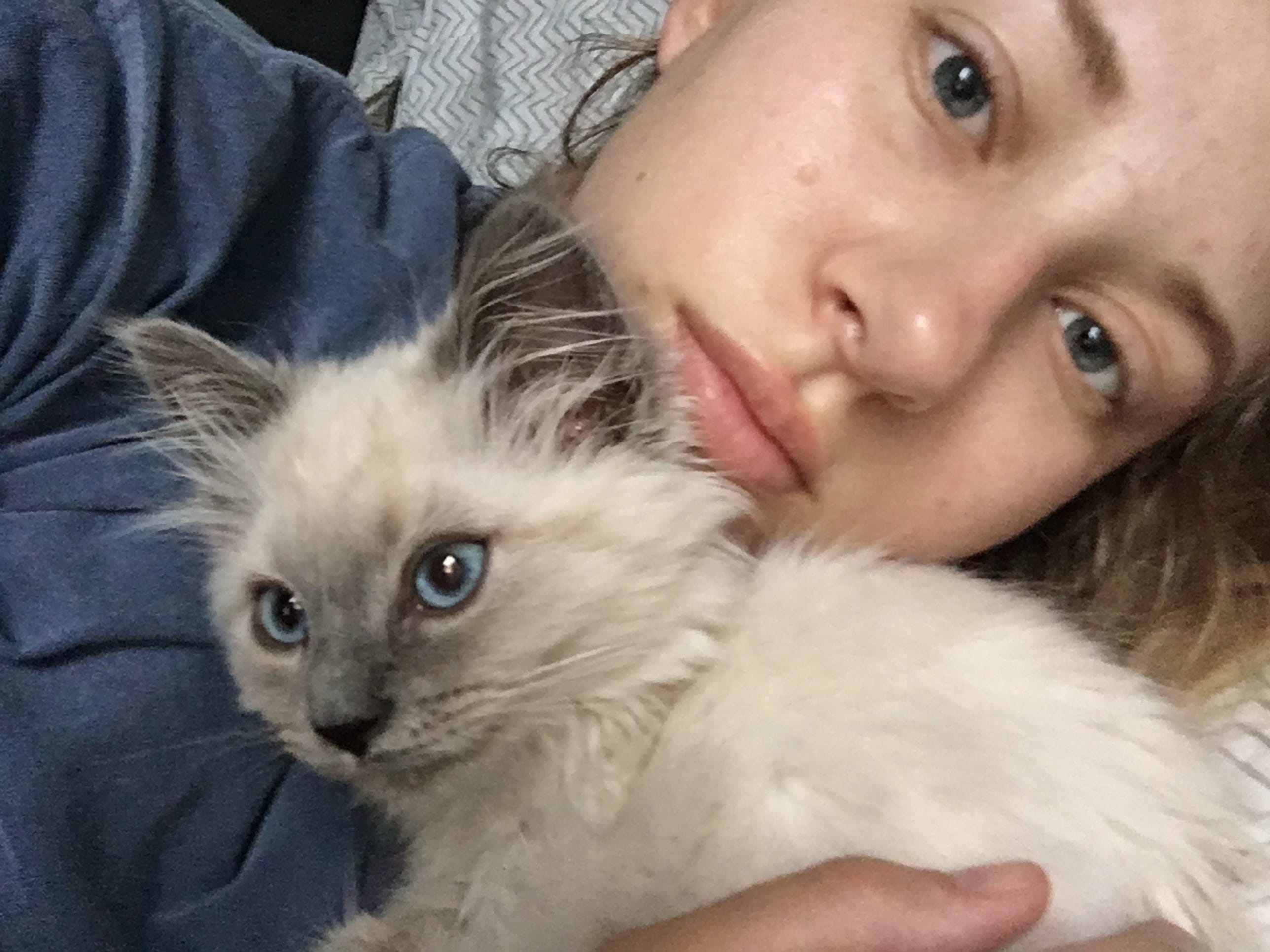
I, too, found a cat in my early twenties and poured all the love I withheld from myself into her. I’d never had a cat before and had no idea what to do with her (though I am a much more anxious person than Katie and never once fed her pink cupcakes), but the responsibility of keeping a tiny kitten alive during what was otherwise a tumultuous and dark time in my life is what kept me afloat. My kitten growing into a cat allowed me to grow into an adult, too. I understood completely Katie’s fixation and immediate love of Silver. Animals can be a lifeline that we don’t even realize we need.
The feelings I had toward Katie, both compassion and frustration, reminded me of my experience with the similarly naive and sympathetic narrator of I Love You, Don’t Die (which I read earlier this year). It isn’t a book I “needed” now, but it’s one I know I would have benefited from 10 years ago. It’s special to read something now and appreciate it as an older but new version of yourself. Reading Kitten was like putting on an old sweater — one that I am, crucially, not sad to take off.
Thank you to the publisher for the e-ARC!
further research
Martha Adams and Nic Marna both did interviews with Stacey Yu that I very much enjoyed!
This list of common cat hazards and toxins, just in case you’re a Katie
your local animal shelter :) send me pics of the cat you adopt
Girls with Long Shadows by Tennessee Hill
this was our book club pick this month! honestly, because I'm lazy, I'm going to rely on the deep-ish dive into this novel that sarah cucchiara and I did for the brand new Literhotties substack, which you can read here:

But, an aside: I have to fight the urge to discuss the points at which I thought, “oh, this author has an MFA” because I think it’s unfair and people work hard for their degrees. It is not something I care about and doesn’t sway me when determining whether to read a book or not; half the time, I’m not looking the book up at all before I start reading, let alone the author’s bio.
But I also think there are some tells that make it easy to think of MFA lit as a monolith. Mostly, dialogue that serves the prose rather than the plot (fine, in theory, until you have teenage girls talking as if they’re in a CW drama) or forced metaphors where there doesn’t need to be one (we need to talk about how us lit fic readers are confusing cliched metaphors with “lyrical prose”).
I’m not saying this book did all of that! And when it occasionally did, as all literary fiction does, I wasn’t mad about it, but it did make me think about how it would fit into the conversation about MFAs I’m seeing floating around a lot on the internet these days. Mostly I think we’re thinking too much about these things, but I do enjoy pondering how the literary landscape is changing and where it’s heading.
You can also subscribe to literhotties here! Behold:
movies
◡̈ = really liked! you can get slightly more on my letterboxd, but only slightly. This made me realize I watched two movies where the premise was a dead sibling and therefore I was crying within the first 5 minutes.
Twinless (2025) ◡̈
Voicemails for Isabelle (2026)
High Fidelity (2000)
The Odyssey (2026) ◡̈
Nirvanna the Band the Show the Movie (2025)
Spider-Man: Homecoming (2017) — I committed to a rewatch of the Tom Holland Spider-Mans before the new movie
The Invite (2026) ◡̈
favorites
Because, as always, you didn’t ask:
My Brilliant Friend tv show — I've only started the first season and I’m reading the fourth book now! I do not want it to end, so I love that the show will prolong it.
French Cowboy’s fig lemonade — summery and sweet, but not too sweet because of the woodiness and spice of the cedar and freshness from the fig. This smells like you set up a lemonade stand underneath a cedar tree. Not sure where the figs come into this scenario, but however they do, the figs aren't ripe yet! I got a sample of this, wore it out one night, and immediately purchased a full-sized bottle.
Foodwise: In DC, my best meal was at River Club, where I had a 9:30 pm carajillo to keep me awake for a 10 pm showing of The Odyssey. Elsewhere, my absolute fav of the month was peach ice cream from The Berry Patch, a roadside farmstand in North Carolina that my parents stop at on their way too and from the coast and that claims the world’s largest strawberry (it’s a building you order your ice cream in).
What were you reading / watching / loving in July? share in the comments!
I’m already looking forward to Women In Translation month now that it’s August, and I’ll be starting with The Story of a Lost Child by Elena Ferrante as the book club sadly finishes up our Ferrante Summer series. But I’m also considering, among others:
Silencio by Clyo Mendoza
Drive Your Plow Over the Bones of the Dead by Olga Togarczuk (finally???)
The Details by Ia Genberg
Tell me if I should prioritize any of these, or perhaps there’s something else I should read first! We all know I have no qualms buying yet another book!
see u next time <3
Meow ❤️
excellent as always and also we need to discuss reading drive your plow over the bones of the dead together because i’ve been meaning to read it for ages