

everything I read this spring
Consumption Diaries #33

Note: This is very long given that it’s three months crammed into one and I will never master the art of brevity. If you’re reading this as an email, beware you might need to open it separately, but also beware to everyone.
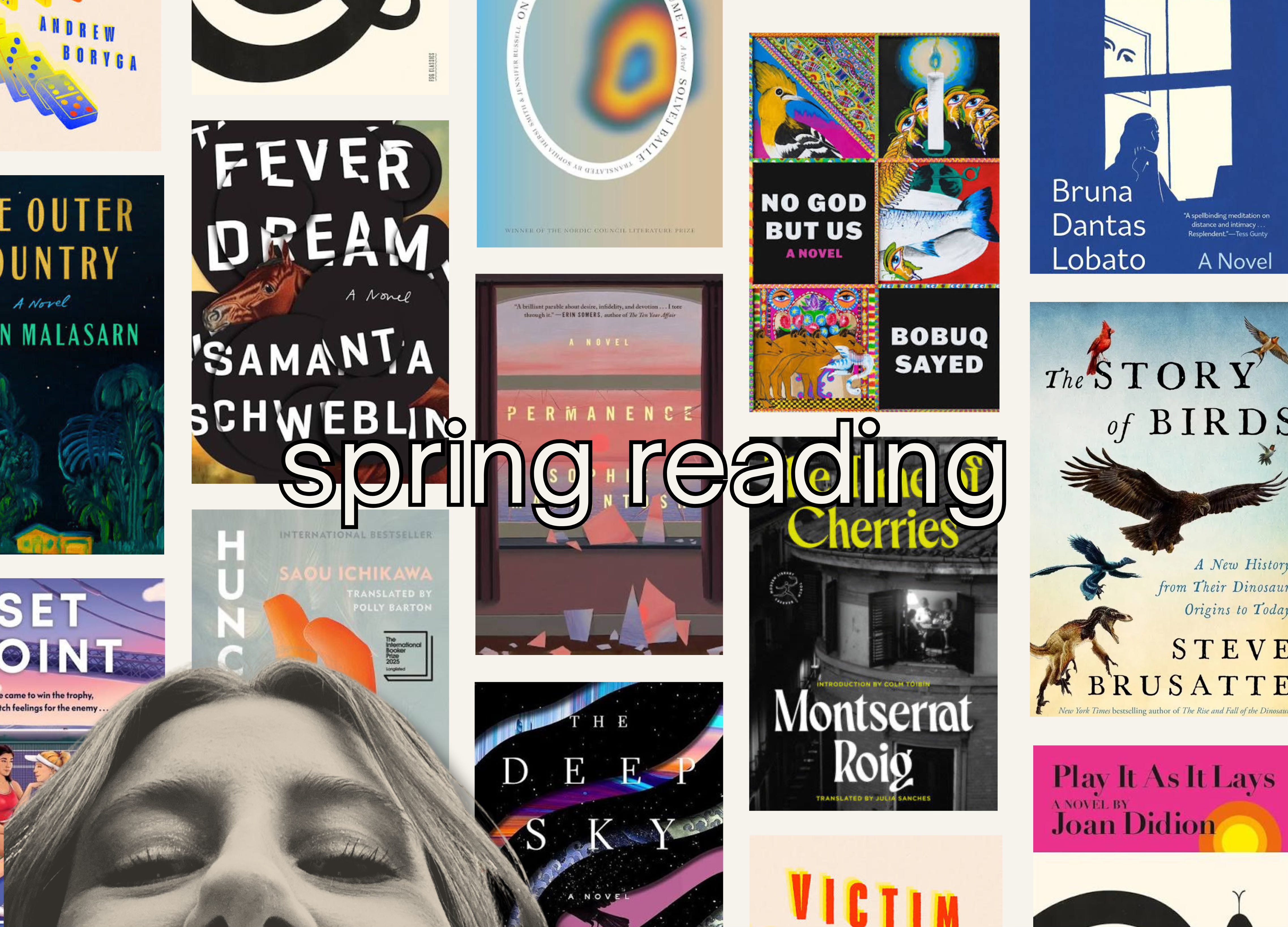
Some months I just don’t have it in me to sit down and write something halfway-thoughtful about the books I read in the previous month. I barely have time to actually read the books, as someone who doesn’t often say no to socializing and also has colossal screen time levels1.
So, as I procrastinated March’s wrap-up day after day well into April, and then well into May, I decided to just lump these three months together. Like Vogue, only worse and uglier, but cheaper. Consider this my Spring edition.
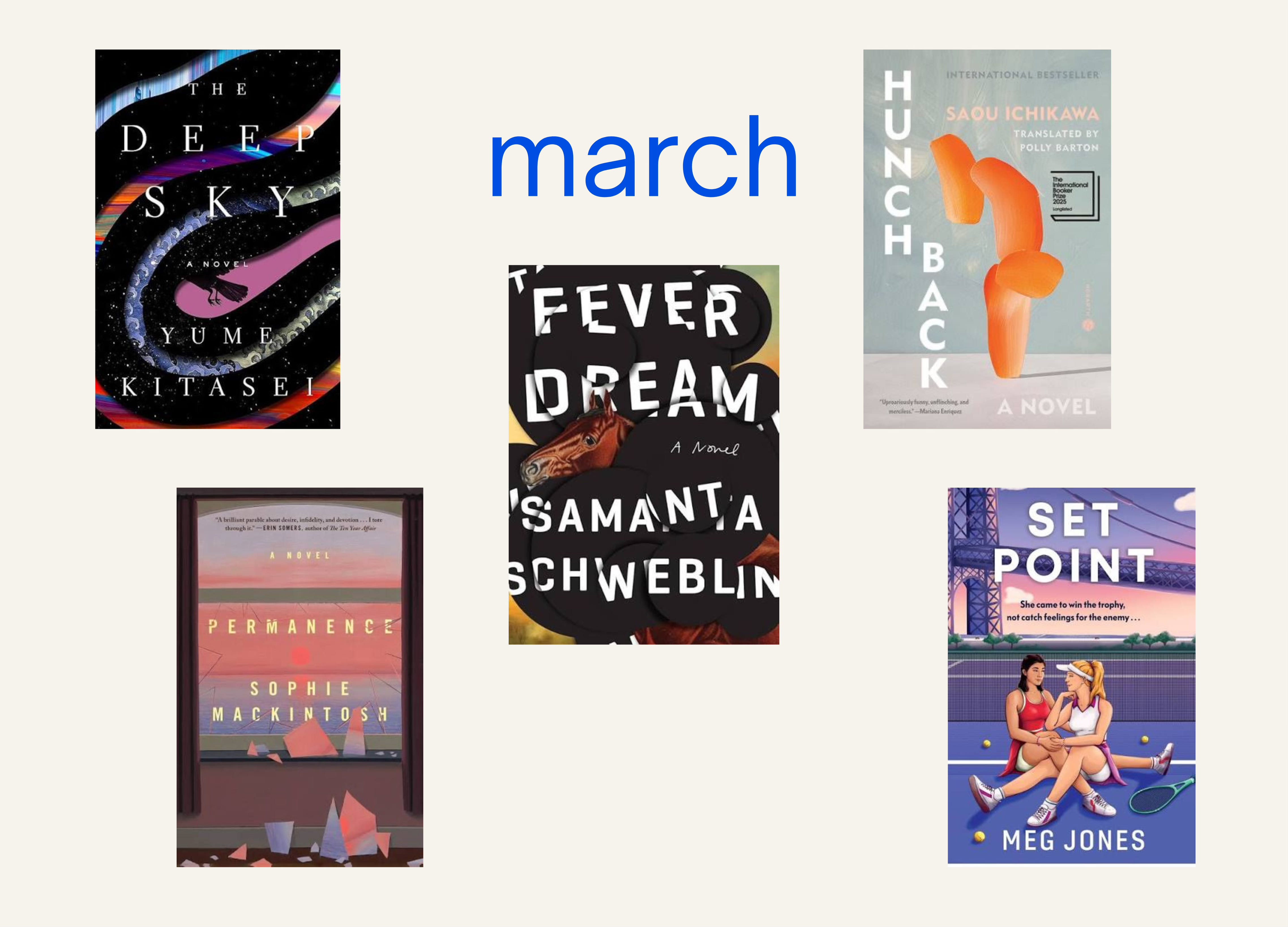
The Deep Sky by Yume Kitasei
At the beginning of March I realized I hadn’t read a space book in a while, and when I looked at my shelf to remedy that, The Deep Sky said hey :)
The book is set in the future, near enough to feel the walls of environmental collapse inching closer but far enough that there is room to ruminate without complete panic. The main character, Asuka, is on a ship hurtling through deep space toward a distant planet deemed livable. The project is highly controversial, with several activist and environmentalist groups opposing the capitalist nightmare of a billionaire loudly decreeing the planet unsalvageable and then profiting from it.
Once they’ve awoken from their deep sleep, only halfway to their destination, there’s a deadly explosion that blows the ship off course. Asuka, who was placed on the ship as a last-minute alternate, has to confront her insecurities and her trauma as she finds herself at the middle of the investigation and her crewmates begin to turn on her.
The Deep Sky is filled with people running from their pasts and selves, all carrying a deep collective trauma that feels almost anticipatory; some day, all humans will share a reality of environmental trauma. We are all watching this marvelous planet shift before our eyes, and we’re watching scientists already look for our salvation in the stars because we understand the reality of our species’ potential for longevity. That makes this book sound bleak, but it really isn’t. I found it surprisingly hopeful, though maybe that’s because it isn’t hopeful for any one specific outcome or future — it’s just hopeful that humans have a future at all, one in which we can continue to put faith in each other.
Permanence by Sophie Mackintosh
I’ve read all of Sophie Mackintosh’s books at this point and I’m perpetually surprised that more people in my same internet book spheres haven’t. She writes prose-heavy lit fic about women, weird and flawed and full of desire. And Permanence is her best yet.
This novel explores the way we make people our homes, except here, home materializes into a real city, exclusive to couples having affairs, and which no one can explain or truly work out the rules of.
The main characters, Clara and Francis, are in love. And they are also having an affair. They know only the secretive versions present during their clandestine meetings, unable to share the parts of a life together that, well, make a life. And then one morning, they wake up next to each other for the first time, in a strange apartment in a strange city that appears to exist outside of the real world entirely. The other city residents are just like them — couples who have only ever been together in the shadows, now able to walk freely in the light.
You can sense immediately that the novelty of Clara and Francis’s situation will ultimately wear off; the excitement of anything new dulls in routine. But isn’t that all romantic relationships? Readers will be tempted to view Clara and Francis’s relationship differently because it is illicit, because Francis has a wife and child and Clara is much younger, but Mackintosh deftly directs readers away from moral judgment calls because that isn’t the point. Without those circumstances, Francis and Clara simply behave as we all do when we are newly in love, before we’ve had a chance to think about what “forever” with another person means or before we’ve folded ourselves into a shape that allows for someone else’s daily monotony to fit into our own. Before we have had to ask ourselves whether love could ever be enough on its own.
I am obsessed with stories of desperation, of characters that explore the extent to which we’re willing to sacrifice for a taste of happiness. Clara’s desire is palpable, her unraveling urgent. What do you do when you’re the sole recordkeeper of your own memories, or when your memories are shared with only one other person who has a completely different account than you? Your perception of your own reality begins to shimmer into mirage.
The plot is made satisfying by Mackintosh’s command of language. Her prose is, as always, lush and hazy, but slightly less so in Permanence than in her previous work, I think, and that’ll probably make this feel more accessible. I hope it does because I want everyone to read it!
Thank you to the publisher for the ARC because I could not have waited until pub day to read this.
Also, because I’ve gotten a lot of questions on this, if this is your first introduction to Sophie Mackintosh and you want to read more, I’d recommend starting with The Water Cure. And Cursed Bread is probably my second fav, after newly crowned Permanence, so much so that I wrote an entire substack based off of my manic rabbit hole google searches.

Fever Dream by Samanta Schweblin, translated by Megan McDowell
As I slowly work my way through the Samanta Schweblin vault, I’m realizing how much of a freak she is (complimentary).
Fever Dream is about, well, a fever dream, told through a woman dying in a hospital clinic, speaking to a boy. The woman is a mother, but the boy is not her son; the boy has a mother, but the woman is not his. But they’re still linked by fierce maternal love and forces outside their control. Fever Dream is akin to a ghost story, but at times it’s hard to say who’s doing the haunting.
Schweblin here is masterful in her ability to build tension, an act I think is considerably harder on a page than on a screen, though I’d love to see an adaptation. It’s hard to parse reality from dream here, the distortion of linear storytelling enough to make you woozy, like trying to focus your eyes after something’s thrown you off balance.
I would like to reread this, honestly, because I think my stubborn commitment to finding logic in the feverish haze that is this book detracted from my experience or pulled me out of it far enough that I was more confused. This is a book that requires readers to surrender to it, which I encourage you to do.
Hunchback by Saou Ichikawa, translated by Polly Barton
We chose this for the March Literhotties Book Club meeting, hoping it would lead to good conversation and reflection on disability and disability representation in literature. And it did! Its average rating on goodreads is 3.35, which is a sure way to intrigue me, and it should intrigue you too, because literary fiction ratings are notoriously low, and women writers are consistently even lower. Add in the author’s disability and you’ve got the perfect storm of “this book isn’t for me so I hated it” reviewers.
And Hunchback is certainly provocative, meant to make you confront your own biases through its narrator, a young woman named Shaka with a congenital muscle disorder that is very similar to the author’s own. She relies on an electric wheelchair to move and ventilator to breathe, causing her immense frustration about people who take for granted their ability to move, eat, bathe, and read unassisted and without meticulous care.
In particular, she wants to be able to express her desire freely, to have sex and get pregnant and even get an abortion, just to feel “normal.” When Shaka enlists one of her caregivers to fulfill this dream, her identity and sense of self is altered, but her commitment to agency and the right to choose what to do with to her body does not falter.
I thought this book was darkly funny and still thoughtful. I could feel the author’s wry humor and independence with each line, as if the story were deeply personal. And of course it is! Though she’s said this isn’t necessarily auto fiction, I wonder if the assumption that it could be is partially responsible for making this a commercial success both in Japan and abroad.
Also, Martha Adams‘s interview with Ichikawa (and translated by Barton) on Books + Bits was immensely helpful in adding context and color post-reading.
Set Point by Meg Jones
During the pandemic, I read a lot of contemporary romance, and before that I read zero. Now, I will make exceptions for Emily Henry or the occasional bout of extreme mental unwellness that will not allow me to read anything else, but I’m pretty much off the romance train. I know this because when I do read one, even a perfectly fine one like Set Point, I am annoyed and bothered even though it’s very likely I stayed up really late to finish it.
So I’m not the correct person to review this because I respect the work that authors put into their books and I understand that this is a me problem, but what I will say is that I’m always happy to have my mind changed (maybe 831 Stories will do it, do I dare?) and I remain open to your recommendations. Set Point was acceptable because it featured a subplot (sports!) and was also sapphic. I cannot tolerate these straight romances between tiny, quirky women and large, grumpy men anymore, y’all.
Thank you to the publisher for the e-ARC!
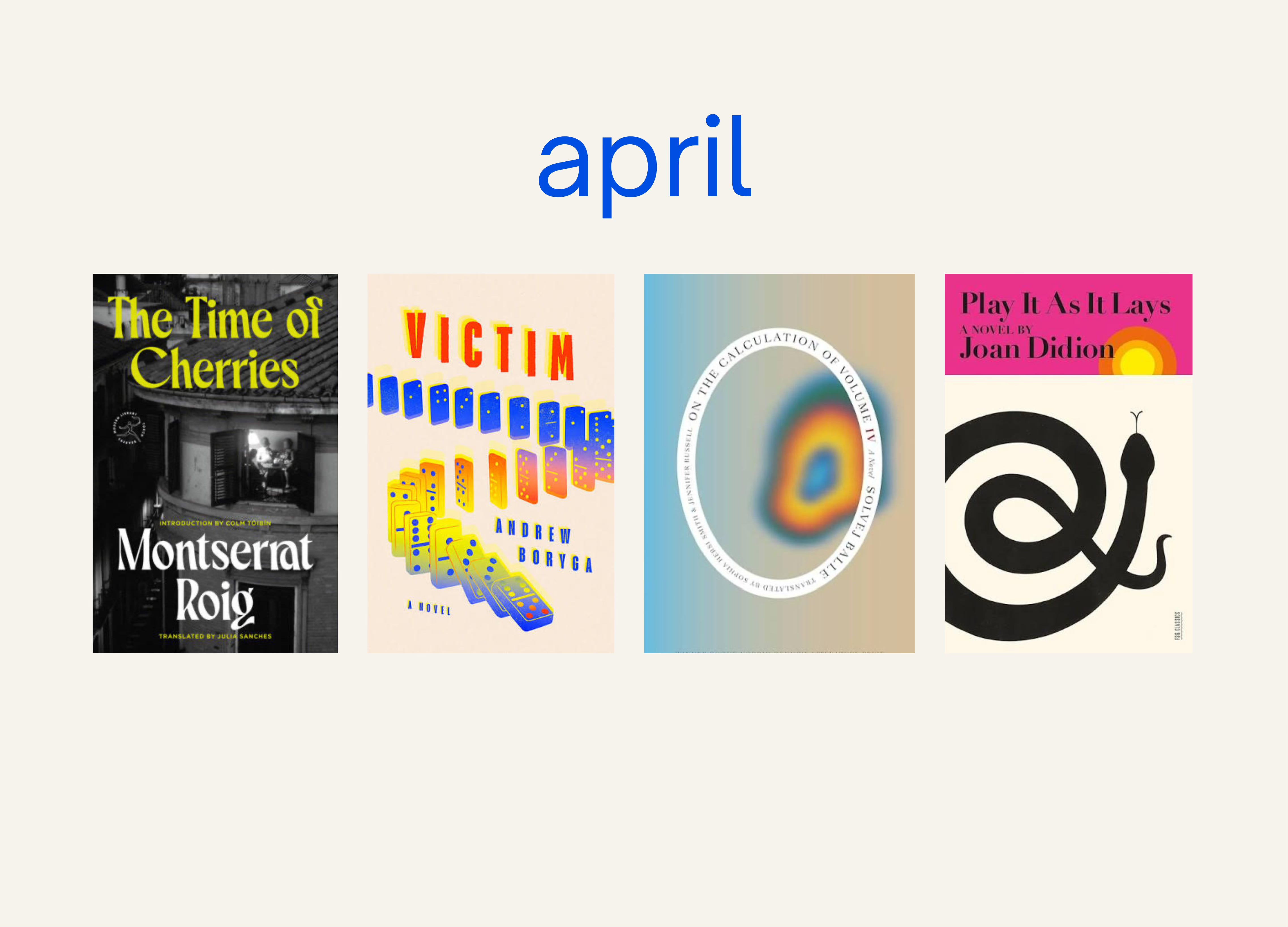
The Time of Cherries by Montserrat Roig, translated by Julia Sanches
Part of Modern Library’s collection of books that have never been translated into English before, The Time of Cherries is my first foray into Catalan literature.
It’s about homecoming, but especially how difficult it can be coming home to a place that holds bad memories. Natàlia is returning to Barcelona after more than a decade abroad during a moment of hope — it is toward the end of Franco’s reign, but not close enough, and returning to political darkness causes Natàlia to reflect on her upbringing, the strain living under fascism puts on individuals, families, and collective society.
The Time of Cherries challenged me; I admit I knew (know) very little of Spain’s history, particularly of Francoist Spain in general and especially in the 60s-70s when this book was set. I was missing a lot of context and wasn’t able to immerse myself in the text with ease, and the writing is also dense enough that, when I wasn’t pausing to look things up, I truly had to focus.
And this is a good thing! It’s good to be challenged! It was a great opportunity to learn more about history and grow as a reader as well. If I hadn’t pushed through, I wouldn’t have experienced such a quietly devastating story of familial love, Catalan culture, and, as Martha Adams put it, your sex life under fascism. By the time I got to the end, I was completely enraptured.
I love reading to make up for the failing American education system. It’s not our fault we know so little of the world, but it is our responsibility to learn more!
Victim by Andrew Boryga
How many times can I mention Martha in one newsletter? I read Victim for her book club, even though I wasn’t able to actually attend the meeting </3
Victim is about Javier, a boy from the Bronx who grows up wanting to be a writer and attends a small liberal arts college on his journey to do so. He has ambition but little in the way of practical motivation, at least not in the way we’ve deemed acceptable. But he is opportunistic, and combining that with astounding naïveté about privilege, he ends up milking his upbringing to further his writing career. And while he’s essentially hustling the white literary world, capitalizing on their guilt (can you blame him?), his childhood best friend Gio’s prison release threatens the entire farce. Here is someone who knows Javi, truly, and who forces him to confront both his long con and the circumstances that allowed it to bloom.
I really enjoyed this book. It challenged me as well, though in a very different way than The Time of Cherries. It asked me to step into the mind of a straight man and to allow him the space to transition from boy to man, however imperfectly. He pissed me off with both his behavior and passive, naive nature at times, which speaks more to my perspective than anything else, but I was still rooting for him.
The socioeconomic and class dynamics make Javier (and his friend Gio) much more sympathetic, as the rich, performative liberals around him and who are manipulating him pissed me off more. I can’t say I wasn’t humbled a little,2 but I think that adds to Victim‘s power to compel us toward empathy.
Statistically I don’t think I read a lot of books by straight men, which I’m just fine with, but I also like reading different perspectives. And upon researching more for this book, I came across a 2024 article, “Where Is All the Sad Boy Literature?” arguing that perhaps we don’t want the perspective of vulnerability from males in literature in the way we demand it in real life and almost expect it from women, à la Sad Girl Lit. While I do think there’s still space for this (there is always space for straight men) and I want to roll my eyes a little, there’s certainly some truth to the fact that regardless of whether cisgender, straight men read Sad Girl Lit or Sad Queer Lit or not, they’re likely not seeking it out for the same reason women or queer people do: to feel seen and understood and validated. We don’t need to see ourselves in books to understand them or enjoy them, certainly not to learn from them, but if we want men to read more, well.
And the author himself responds to this article in his substack “Do we really want more male vulnerability in fiction?”, (he links to a few other good pieces examining this subject that you may have read throughout the years) extending the question of whether we want vulnerability from men to how we want it from straight working class men. His argument is that we are scared of male vulnerability in literature if it doesn’t sound like what we want it to, which I suspect is partly because of a lifetime, and generations back of lifetimes, of male-induced trauma that makes reading about unpalatable men or even just flawed men feel deeply uncomfortable, perhaps even threatening if it’s done too well and feels too real.
Everyone, and maybe particularly women, is increasingly reading for escape, and perhaps that means we are only reading about perfect, dreamy men and men who are clearly branded as one-note villains. Boryga asks the question: “Is there really an appetite out there for this work? Or is there simply an appetite for male voices that look and sound acceptable enough?”
Whether you love them, hate them, fuck them, or feel completely indifferent toward them, if we want to dismantle harmful modern masculinity, we cannot do so without men themselves. Victim does a brilliant job in reminding me of this.
On the Calculation of Volume IV by Solvej Balle, translated by Sophia Hersi Smith and Jennifer Russell
If you’ve heard me talk about books in the past year, you’ve likely been subjected to me talking about the On the Calculation of Volume series. Today is not the day I quit.
I can’t really talk about book IV without talking about the first three, and I can’t really do that without major spoilers, which the entire series relies on and without would lose much of its appeal, so I’ll keep this short-ish: I love these books so much.
Honestly, IV lost me a bit at first; it’s a departure from the previous three in some big ways, and I couldn’t tell if I liked where it was heading. No surprise, I ultimately did. The entire world of exclusively November 18ths has shifted by this point in the series, and you can feel the entropy increasing in a way that you don’t in the first three books, where Tara is still getting her footing. Whether this will be going completely in the direction of the Second Law of Thermodynamics and the entire thing will, much like our universe some day, completely cease to exist once it’s reached maximum chaos, who knows.
I can’t predict where this is going at all, and that’s part of why it’s been so fun. This series is not very plot heavy despite such a profound premise and instead relies on the narrator’s introspection to paint a picture. Readers are given much to think about — what would we do in this same scenario, how would we handle it, how would we explain it — and that reflection propels the novels forward.
November 18 feels increasingly claustrophic, and by the time you reach the fourth installment, Balle’s world has never felt more unsustainable. Something must give, and I am delighted that we still have several more books before the story concludes.
Play It as It Lays by Joan Didion
This was the April book for Literhotties, and the first that sarah cucchiara and I had read before. I am always down for a reread because I don’t do it enough, and each time I’m reminded why I should.
The last time I read Play It as It Lays, I was new to my 30s, trying to reckon with my choice to be a purposely child-free woman, and coming out of the other side of the pandemic that I believed, at the time, had robbed me of my prime years (arbitrarily determined to be my late 20s). The main character, Maria, pissed me off.
Since then, I’ve entered my mid-30s and grown softer in some ways, harder in others. And Roe v. Wade was struck down, reminding me how women like Maria had to seek abortions (with this also a plot line in The Time of Cherries above, I’ve done a lot of self-reflecting on what I’ve taken for granted as a well-off white woman, as far as reproductive care goes).
We picked Play It as It Lays because we wanted to examine the roots of so much of the women’s literary fiction we read today, surely all influenced in some way by Joan Didion. You could certainly get much deeper into the origin of sad girls and weird girls in literature, and this would be a fascinating class syllabus (can someone write this for me!), but Didion isn’t a bad place to start.
What I was most struck with on this second read was how much I’ve read in the last few years that feels reminiscent of Play It as It Lays. Joan Didion as a whole, really. Anything about California, anything about the desert, all stories of mental illness in women, all stories of women controlled by men.
That isn’t to say all of these were copying Didion or even using her as inspiration; some of Play It as It Lays is simply generic enough that it can’t really be “copied”; it’d be like someone claiming everyone is copying them while wearing some generic t-shirt from an Aritzia ad they saw on instagram.3 But I love when books are in conversation with each other, and I consider this to be a foundational text in the Sad Girl Lit genre.
Other books I was reminded of while reading were Valley of the Dolls by Jacqueline Susann, who was a contemporary of Joan’s so it seems more likely that they were working off the same subject matter, heavily medicated rich women, rather than each other’s work; and The Great Gatsby, somewhat surprisingly, for Daisy’s lines about the best thing she can hope for her daughter to become is a beautiful little fool.
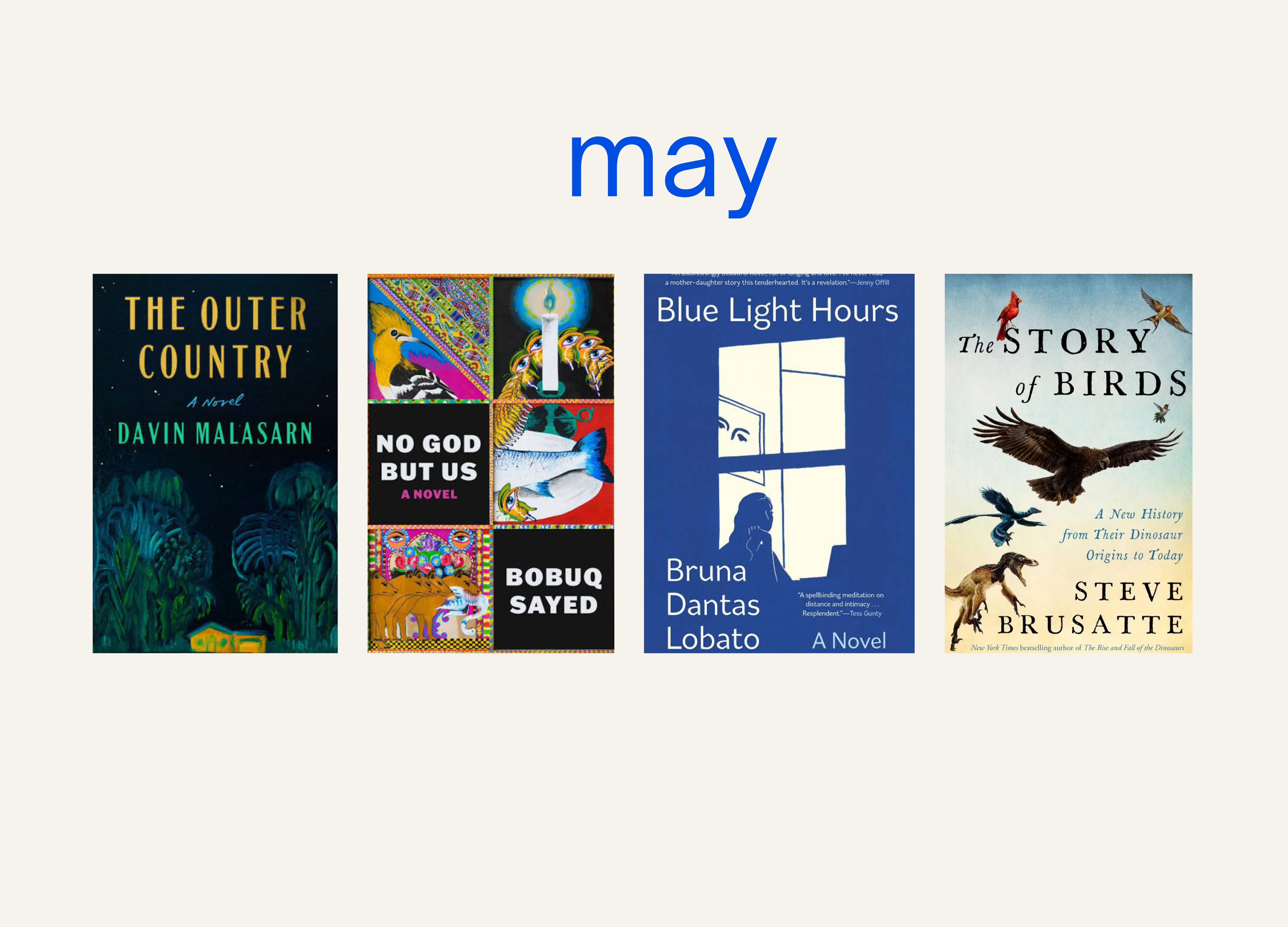
The Outer Country by Davin Malasarn
I haven’t seen a ton of buzz for this book, a multigenerational immigrant family drama about queer identity and exploration, but it published in May and would be a great addition to any summer reading list.
The Outer Country begins with two sisters, Manda and Siripon. They’re estranged and also physically separated after Siripon leaves Thailand for the US and Manda stays behind, until Manda comes to help with the birth of Siripon’s only child, Ben. From then on, Ben is the string that keeps his family together; Manda steps in, and oversteps, as a second mother to Ben, and the sisters try to set aside their differences for the sake of the boy they both love.
But, when Ben exhibits some feminine behavior as a child, Manda believes him to be possessed and secretly arranges for a Buddhist exorcism, setting off a chain reaction that permanently alters Ben. As the book progresses and Ben ages, growing into himself as a gay man, we learn more and more of his perspective, the way he’s swallowed himself for the sake of his family, and the way the trauma has never left him.
It’s devastating to read about such a young boy being punished in such a way, stripped of who he is out of fear. And because we get the perspectives of all three — Manda, Siripon, and Ben — it’s even more devastating to witness them so close to understanding and acceptance but without the language and guidance to fully satisfy either.
The author said he wanted to explore a story where the main conflict comes less from immigration itself or a new country and more from complicated, toxic family dynamics. While this is of course nuanced in reality, removing the focus from the daily horrors of immigration allowed Malasarn to explore the conditions and depths of familial love beyond traditional immigrant narratives of daily struggles for survival. Unconditional love exists in all stories, as does conditional love, but how does generational trauma mold our definitions of it?
thanks to the publisher for the galley copy!
No God but Us by Bobuq Sayed
I’ll just say up front, I loved No God but Us and also, unfortunately, it’s fallen into the void of my mind where I sometimes struggle to talk about books I love. It is poignant literature, but it also felt so important to the current state of both books and humanity.
No God but Us follows two Afghan men — Mansur and Delbar — who have been forced out of their countries (Iran and the US) because of their sexualities and ultimately end up in Istanbul. It isn’t the safe haven of progressive acceptance they long for and deserve as it moves toward authoritarianism itself, but it is a place in which they begin to ask themselves the question, “what do I truly want, and what does that mean for my life?” And more importantly to the story, “what am I allowed to want?” Having left everything behind, the individuals in the vibrant, queer, refugee community that Mansur and Delbar become part of — and that they meet each other in — are not dreaming so big as to demand the world, a world that has already challenged their existence in so many tragic ways. Their hope is of survival, of peace and stability.
The novel alternates in perspective between Mansur and Delbar, both up until they enter each other’s lives and then after, as the two feel a natural magnetic pull toward each other. Delbar in particular is fascinated by Mansur, the first gay Afghan man he’s ever met, but Delbar is only arriving in the middle of Mansur’s journey toward refugee status. Delbar is coming from the US, a completely different lived experience than Mansur’s life of displacement. Through their competing priorities and complicated dynamics remains a magnetic and compulsive attraction.
Like The Outer Country, some of the conflict comes from familial expectations, particularly for Delbar, who leaves his Afghan community in the suburbs of DC after being outed and swiftly rejected. But there’s more to it here; both men, and their community in Istanbul as well, have had to make incredible sacrifices for their own survival, a direct consequence of politics and culture. The personal and political are impossible to untangle, and it is at times heartbreaking and at others inspiring to watch them press on in hopes of freedom anyway.
What struck me most about No God but Us is just how necessary it feels. Queer lit obviously exists and within that genre sits some incredible non-white queer lit, but very little (if any) of what I’ve read is removed from the Western gaze. Sayed’s intention to do so is what feels so needed in literature, and their ability to pull it off is like nothing I’ve read before. As they pose the question “who is there to answer to?”, the reader moves forward and begins to imagine a world in which the title is possible — no god but us.
Thank you thank you to Ezra Kupor for the ARC — now that’s what I call a galley brag.
Blue Light Hours by Bruna Dantas Lobato
And once again, a book club pick! We read this endearing story of a mother and daughter living apart for the first time during the same month as Mother’s Day — sorry, everyone.
The unnamed daughter and mother that this novel is built around are both struggling with their new identities after the daughter leaves Brazil for the first time to attend college in Vermont. The daughter is adjusting to an alien environment while struggling to find her footing in those crucial first forays into adulthood, and the mother is alone for the first time and discovering what that means.
The two keep in touch frequently via Skype calls, nearly every day, their faces on their screens a respite of familiarity in their new lives. Structurally, the book is split in two over the course of the daughter’s college tenure: It begins with the daughter’s perspective and then shifts to the mother’s in the second half, necessary perspective in understanding both women and their close relationship.
The daughter spends most of her time studying, and though she makes a few good friends, it takes her some time to feel like she can make a new home here, too. She often forgoes socializing to call her mom, sometimes simply staying on Skype for hours in quiet companionship, pretending they’re in the same room.
For her part, the mother is navigating her identity as a mother who is not physically mothering her child anymore, which is to say she is struggling with her identity as a woman. Moms so often lose themselves in their children, a level of devotion that costs them their individuality, but the more nuanced reality is that we fail to see our parents as complete adults and flawed humans until we’re adults as well and have taken a step back from our roles as children. Before our mothers were mothers, they were simply women, and before that they were girls, and what seems to be forgotten most is that they, like us, are daughters.
Some women at book club discussed whether it was unfair of the mother to maintain such constant connection with her daughter, making her worry and feel too tethered to truly blossom in school. There is certainly a relatable level of worry for aging parents here, but I didn’t find that to be because the mother was guilt-tripping her daughter or purposely holding her back. I interpreted the daughter as maintaining her close relationship with her mother as a comfort and grounding. Her worry felt like a product of homesickness rather than a sense of obligation that she resented and that kept her from integrating fully into a culture that she didn’t feel like she belonged to regardless of how often she worried over her mom.
And it is that culture that I think so strongly influences a reader’s experience with this book, which makes for a good discussion. Personally, I come from the culture the daughter is dropped into and doesn’t understand: middle class Americans who were primed for their homogeneous university experiences their whole lives. There are also family dynamics at play here that are entirely normal in Latino families but aren’t as understood in the US (actually how and why are we so rude to our parents), and I think a mother-daughter relationship is completely different without another parent or siblings around. Boundaries are blurred, the bond is deeper.
The Story of Birds: A New History from Their Dinosaur Origins to the Present by Steve Brusatte
Once you turn 30, you must become a bird girl, they told me. OK, sure, fine, but I was a dinosaur girl first! Lucky for me, birds are dinosaurs, and The Story of Birds spared no detail in reassuring me of that.
There are plenty of bird-related books out there for the avid bird fans, but I don’t know that I am avid enough for many of them. The Story of Birds, though, isn’t really about modern birds; it focuses on how modern birds came to be, an archaeologist’s perspective on their evolution into the incredibly impressive animals that they are today but also probably always were.
I really loved Brusatte’s first two books, The Rise and Fall of the Dinosaurs and The Rise and Reign of the Mammals, so The Story of Birds perfectly rounded those two books for me. I am always trying to convince people to read Dinosaurs and Mammals, so I can’t wait to add a third to the mix. All are incredibly accessible while still being scientific enough for those of us who want to know the details. And the history of scientific discovery is always woven throughout seamlessly, from the first to discover fossils to the impressive scientists of today.
Brusatte also writes these kind-of devastating, obviously fictional narratives of extinct creatures, from dinosaurs to giant penguins. Creative liberties aside, they have helped my brain visualize and understand the earth millions of years ago. Plus, his tale of what it was like for dinosaurs when the meteor hit 66 million years ago truly haunts me today! And isn’t that what we’re all here for anyway.
I mostly listened to this as an audiobook (shocking for me), but thank you to the publisher for the e-ARC as well!
movies
I’ll spare you the list of all movies I watched this spring, but I still love movies so here are my favorite first-watches instead; if you actually, somehow, care about all of them or want to see my “reviews,” here’s my obsessively updated letterboxd.
Project Hail Mary
The Drama
Sirāt (this is on my list only because it was a LEAST favorite and I need to tell everyone to not watch it)
Best in Show
Children of Men
Obsession
Thanks for making it this far! tell me — what did you love this spring (if you’re in the northern hemisphere)? What did you read? Have you read any of these books? I would love to hear your thoughts in the comments!
the only time I ever wanted to be an influencer was to get one of those damn Bricks for free because the price is a scam
there is a scene where they are apartment hunting and tour a new luxury apartment building in Brooklyn that displaced residents and drove up the cost of living; I am currently ranting about rich performative liberals from my very own one of these buildings in my historically Latino and Black neighborhood in Washington DC.
I am NOT calling Joan Didion generic or saying she’s like Aritzia!!!
I also loooooooooved permanence
laughing at “i am not calling joan didion generic or saying she’s like aritzia”